In February 2025, Andrej Karpathy — OpenAI co-founder and former AI director at Tesla — posted a tweet that would permanently change how software gets built:
"There's a new kind of coding I call 'vibe coding', where you fully give in to the vibes, embrace exponentials, and forget that the code even exists."
Within weeks the term was everywhere. By November 2025, Collins Dictionary named "vibe coding" its Word of the Year. And by early 2026, 92% of US-based developers had adopted some form of it in their daily workflows.
This isn't a developer trend you can ignore — even if you're not a developer. Vibe coding is reshaping how software gets built, how fast products reach market, and what it costs to build digital tools for your business. Here's what you need to know.
What Is Vibe Coding, Exactly?
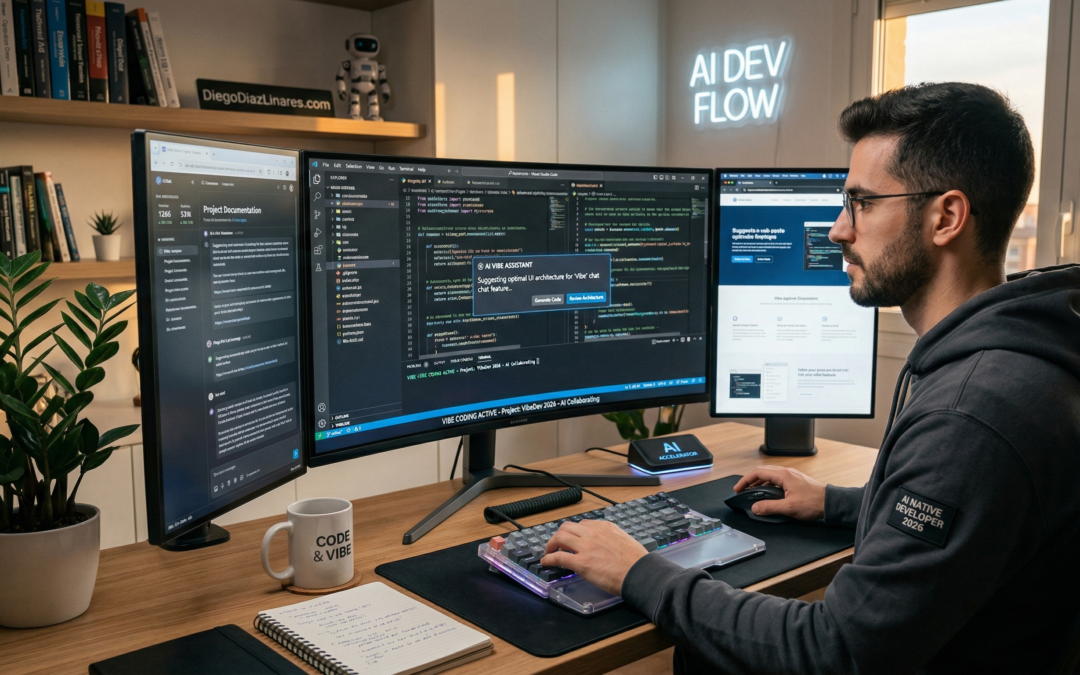
Vibe coding is AI-first software development: you describe what you want in plain language, AI generates the code, and you refine through conversation — without needing to write or even fully read the underlying code.
The typical workflow looks like this:
- You describe what you want to build in plain English: "Build me a dashboard that pulls sales data from our Google Sheet and shows a weekly revenue chart."
- The AI tool writes the code, creates the files, and connects the components.
- You test it, describe what needs to change, and the AI refines it.
- Repeat until it works.
What used to take an experienced developer a full day can now be built with a few well-crafted prompts in under an hour.
The shift has been dramatic. The global market for AI-assisted coding tools is projected to reach $8.5 billion in 2026, up from just a few hundred million in 2024 — one of the fastest market expansions in tech history.
Why 2026 Is the Tipping Point
Vibe coding in 2025 was experimental. Vibe coding in 2026 is a structured, mainstream development methodology adopted by 87% of Fortune 500 companies.
Three things changed:
1. The Tools Got Dramatically Better
Early AI coding assistants could generate snippets. Modern tools understand your entire codebase — every file, every function, every dependency — and can execute complex, multi-file changes autonomously. They don't just suggest code; they plan, build, test, and fix their own work.
2. The Tool Ecosystem Matured and Specialized
The market has fractured into distinct categories, each targeting a different user:
- Cursor — the AI-native IDE for professional developers. As of 2026, arguably the most widely adopted AI development tool among engineers. Its "Composer" feature lets you describe a multi-file change in plain English and watch it propagate across your codebase.
- Replit Agent 3 — best for those who want an AI that tests and fixes its own work autonomously.
- Lovable — designed for going from idea to beautiful MVP in minutes, no coding background required.
- Bolt.new — full-stack code generation in a browser environment.
- v0.dev — specialized in design-to-code, turning UI mockups into working components instantly.
- Claude Code — the top-ranked CLI coding agent for autonomous multi-file operations, with 51,000+ GitHub stars.
3. The Business Case Became Undeniable
A 3–5x acceleration in prototyping speed. 25–50% faster delivery on routine development tasks. The ability for a non-developer founder to ship a working MVP over a weekend. These are not theoretical gains — they're being reported by development teams across the US right now.
The Real Numbers: What Vibe Coding Is Delivering in 2026
The productivity data is striking:
- 74% of developers report increased productivity when using vibe coding approaches
- 41% of all global code is now AI-generated — 256 billion lines written in 2024 alone
- 87% of Fortune 500 companies have adopted at least one vibe coding platform
- Senior developers (10+ years experience) report 81% productivity gains — they use AI for routine implementation while focusing their expertise on architecture
But the data also shows real risks worth understanding:
- 63% of developers have spent more time debugging AI-generated code than they would have spent writing the original code themselves — at least once
- AI-generated code shows a 1.7x higher bug density than human-written code on average
- Roughly 45% of AI-generated code contains security vulnerabilities when reviewed by automated tools
The takeaway isn't that vibe coding is bad — it's that vibe coding without guardrails is risky. The teams getting the best results treat AI output as a draft, not a finished product.
What This Means for Your Business (Even If You Don't Code)
Vibe coding isn't just a story for developers. It changes the economics of software for every business.
Software Is Getting Cheaper and Faster to Build
If you've been putting off a custom internal tool because development quotes were too high or timelines too long, that calculus is changing. A competent developer using AI-native tools can deliver in days what used to take weeks — and charge accordingly.
Non-Technical Founders Can Now Build MVPs
Tools like Lovable and Bolt.new genuinely allow non-developers to ship functional software. If you have a business idea that requires a digital product, the barrier to testing it has never been lower.
Your Tech Vendors Are Already Using These Tools
Whether or not you're aware of it, the developers and agencies you hire are already using AI-assisted development. Understanding what that means for code quality, security, and maintainability is an important question to ask in any vendor conversation.
Custom Internal Automation Is Within Reach
Many businesses rely on expensive software subscriptions for tools that could be replaced by a custom, purpose-built internal app — built in days with AI-native tools, maintained cheaply, and owned outright. That option is now realistic for businesses that couldn't have considered it two years ago.
The New Paradigm: From Code Writer to AI Architect
The most important shift happening in 2026 is not that AI is replacing developers. It's that the best developers are evolving from code writers to AI architects — people who know how to direct AI effectively, review its output critically, and take full ownership of what ships to production.
The skills that are rising in value:
- System design and architecture — knowing what to build, not just how
- Prompt engineering for code — crafting instructions that get reliable, secure results
- Code review and security auditing — catching what the AI misses
- Business-to-technical translation — understanding what a business actually needs and expressing it clearly to an AI
The skills declining in value:
- Writing boilerplate code from memory
- Manual syntax debugging
- Repetitive implementation work
This is not the end of programming. It is the end of programming as pure manual labor — and the beginning of programming as a higher-order discipline.
How to Start Engaging with Vibe Coding Right Now
You don't need to become a developer to take advantage of this shift. Here are practical first steps:
If you run a business: Audit your software stack. Identify the custom tools or automations that would save your team the most time. Get quotes from AI-assisted developers — they'll be faster and cheaper than traditional development shops.
If you're a developer or on a tech team: Start with Cursor or Claude Code on a low-stakes internal project. Build familiarity with the workflow before applying it to production systems. Establish code review standards specifically for AI-generated output.
If you're evaluating vendors or developers: Ask directly: "Are you using AI-assisted development tools? How do you handle code review and security testing for AI-generated code?" The answer will tell you a lot.
The Bottom Line
Vibe coding went from a tweet to the Collins Dictionary Word of the Year in under 12 months. It is now a multi-billion-dollar ecosystem adopted by the overwhelming majority of US developers.
Software development is not dying — it's accelerating. The question is not whether AI-native development will affect your business. It already is. The question is whether you're positioned to benefit from that acceleration or catch up to it later.
The paradigm has shifted. The tools are here. The only thing left is deciding what to build.
Ready to Build Something With AI?
At Diego Diaz Linares, we combine 11 years of WordPress expertise with deep AI and Python engineering to build custom digital solutions — faster, smarter, and with the full rigor that AI-generated code demands.
Contact us today and let's talk about what we can build together.