
Something quietly extraordinary is happening in 2026.
AI agents are no longer just reading emails, generating reports, or answering customer support tickets. They are now opening wallets, making payments, purchasing API access, and settling contracts — all without a human ever touching a keyboard.
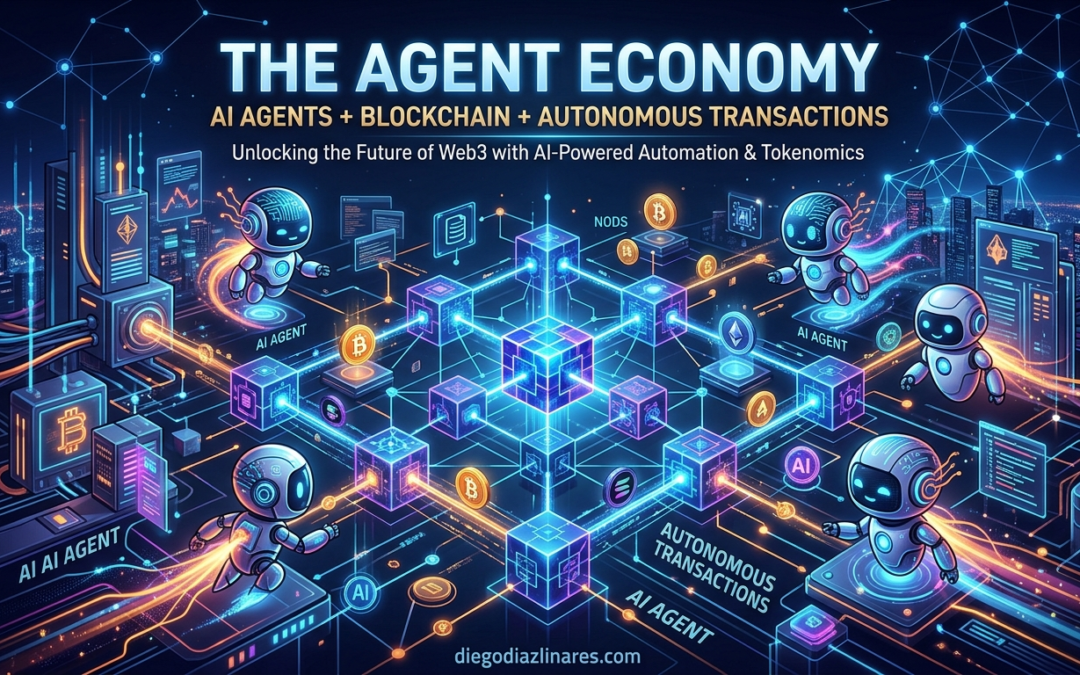
This is what experts are calling the Agent Economy: a new layer of the digital economy where software agents act as autonomous economic participants, powered by AI and settled on blockchain.
If that sounds like science fiction, it's not. It's happening right now — and it's about to reshape how businesses think about payments, automation, and digital infrastructure.
What Is the Agent Economy?
The Agent Economy refers to a system where AI agents don't just complete tasks — they conduct economic activity on behalf of businesses and individuals.
Think about it this way. Today, when your AI agent needs to call an external API, someone on your team has to manage that subscription, pay the invoice, and renew the contract. In the Agent Economy, the agent does all of that itself — it detects the need, identifies the service, pays the fee in real time, and keeps a verifiable audit trail on-chain.
The key enablers making this possible in 2026 are:
- AI agents that can reason, plan, and execute multi-step tasks autonomously
- Stablecoins that allow near-instant, low-cost programmatic payments globally
- Smart contracts that enforce rules automatically without intermediaries
- Blockchain infrastructure that provides a neutral, verifiable settlement layer for machine-to-machine transactions
Why Blockchain Is the Perfect Infrastructure for AI Agents
Here's the problem with traditional payment systems: they were designed for humans.
Credit cards require login credentials. Bank transfers take days. Invoices require human approval. None of that works when you have a software agent that needs to pay for a GPU rental, a data feed, or an API call — in real time, automatically, and at scale.
Blockchain solves this at the infrastructure level. Here's how:
1. Programmable Payments via Smart Contracts
Smart contracts can already settle a dollar payment globally in seconds. In 2026, emerging protocols make that settlement programmable and reactive: agents can pay each other for data, compute time, or API calls instantly — without invoicing, reconciling, or batching.
2. Stablecoins as the Settlement Layer
Stablecoins processed an estimated $46 trillion in transaction volume in 2025 — more than 20x the volume of PayPal and approaching the volume of ACH. They are becoming the de facto currency of the Agent Economy because they combine the stability of the dollar with the programmability of crypto.
3. Agent Wallets with Built-In Controls
2026 has seen significant development in what's called "smart wallet primitives" — wallets specifically designed for AI agents. These include:
- Daily and per-transaction spending limits
- Allowlists of approved contracts, assets, and counterparties
- Audit logs that link every agent decision to an on-chain action
- Emergency stop switches if abnormal behavior is detected
This means businesses can give agents real economic authority — without giving them unconstrained access to company funds.
Real-World Use Cases Emerging Right Now
AI Agents Buying Compute on Demand
Instead of a company pre-purchasing a fixed amount of cloud GPU time, an AI agent monitors workload demand in real time and autonomously purchases compute resources from decentralized GPU marketplaces — paying with stablecoins, only for what it actually uses.
Autonomous API Marketplaces
Platforms like SingularityNET and Fetch.ai are building decentralized marketplaces where AI agents can buy, sell, and license AI tools and data from each other — using blockchain for coordination, usage tracking, and micropayments. One agent can hire another agent's specialized capability for a task, pay it automatically, and move on.
Self-Settling Prediction Markets and DeFi Protocols
Smart contracts can now trigger, settle, and distribute payments entirely based on real-world outcomes — with no human involvement. AI agents monitor conditions, execute trades, and close positions in real time, with the blockchain serving as the neutral arbitrator.
Cross-Business Workflow Payments
When an AI agent working for Company A needs data from Company B's agent, it can negotiate access, make a micropayment, receive the data, and log the transaction — all within a single automated workflow. No contracts, no invoicing, no accounts payable team involved.
The Regulatory Tailwind: Why 2026 Is the Tipping Point
The Agent Economy is not just a technical story — it's a regulatory one too.
The U.S. GENIUS Act, passed in July 2025, created the first comprehensive federal framework for stablecoins, establishing clear rules on reserves, issuers, and consumer protections. This single piece of legislation removed the biggest blocker for institutional adoption of blockchain-based payments.
Analysts at Grayscale and other crypto-focused firms are describing 2026 as the "Dawn of the Institutional Era" — a moment where crypto stops being a speculative bet and starts being financial infrastructure.
For businesses, this means the risk of building on stablecoin-based payment rails has dropped significantly. The regulatory foundation is now solid enough to build on.
What This Means for Your Business
You don't need to be a crypto company to benefit from the Agent Economy. Here's what forward-thinking businesses are already doing:
1. Automate vendor micropayments. If your workflows regularly call external APIs or data services, stablecoin-based micropayments can eliminate invoicing overhead entirely.
2. Explore decentralized compute for AI workloads. Tokenized GPU markets are becoming a real alternative to traditional cloud providers, especially for bursty AI workloads.
3. Build agent wallets with governance controls. Before your agents need to transact, design the policy layer — spending limits, approved counterparties, audit requirements. This is now a governance question, not just a technical one.
4. Watch the stablecoin infrastructure. Companies like Visa and major banks are already building stablecoin settlement capabilities. Getting familiar with how these rails work puts you ahead of competitors who will scramble to catch up in 2027.
The Bottom Line
The internet allowed information to move at the speed of light. Blockchain — combined with AI agents — is allowing value to move at the same speed.
In the Agent Economy, software doesn't just assist human economic activity. It participates in it. Agents detect needs, find services, negotiate terms, make payments, and verify outcomes — autonomously, verifiably, and at scale.
This is not a prediction for 2030. The infrastructure is being built right now. The regulatory framework is in place. The agent wallets are being standardized. The stablecoins are already processing trillions.
The businesses that understand this shift today will be the ones designing the workflows of tomorrow.
Want to Build AI-Powered Workflows for Your Business?
At Diego Diaz Linares, we help businesses design intelligent automation systems — from AI agent workflows to blockchain-integrated payment pipelines — that actually deliver results.
Contact us today and let's explore what the Agent Economy could look like for your operation.