If you’ve spent more than five minutes on social media today, you’ve seen it: AI Slop. It’s that generic, uninspired, and often slightly-off content and code that flooded the internet over the last year. In 2026, the novelty of "the machine can do it" has officially worn off.
For American businesses, the stakes have changed. Automation is no longer about just doing things faster; it’s about doing them with precision, security, and a human soul.
The Python Solution to Generic AI
As a developer, I’ve seen countless companies try to replace entire workflows with "black-box" AI tools, only to see their brand authority crumble. This is why my approach to AI Automations is rooted in Python.
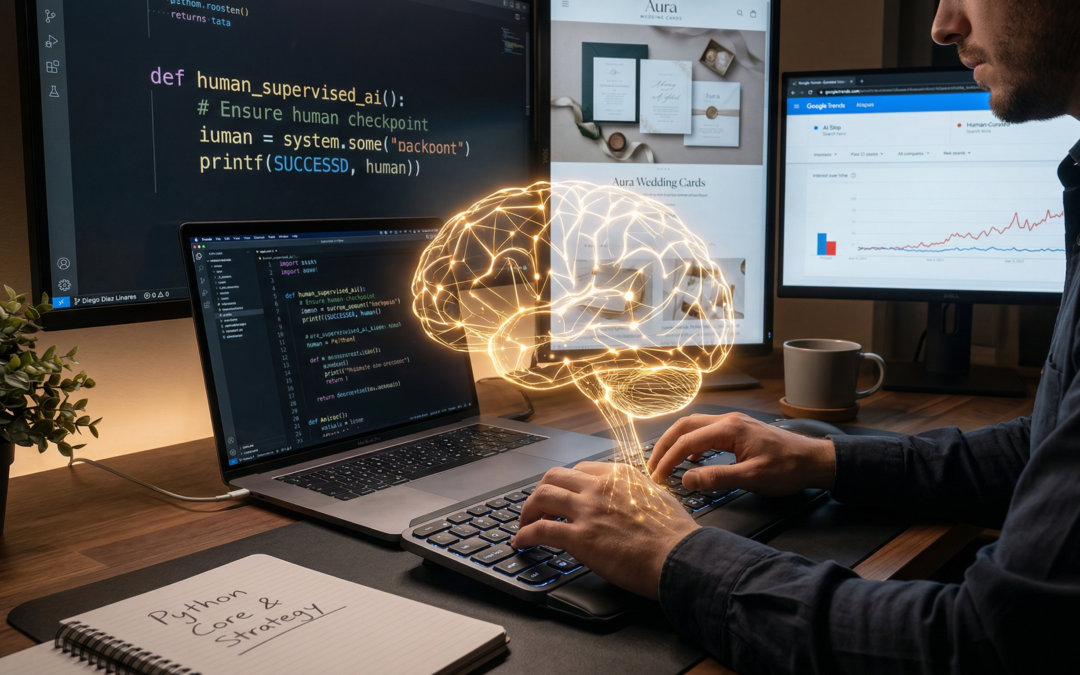
Python allows us to build transparent, modular systems where the AI handles the heavy lifting—data processing, pattern recognition, and initial drafts—while leaving the strategic steering wheel in human hands. When we build an automation script in Python, we aren't just letting an LLM run wild; we are creating a structured environment with "Human-in-the-Loop" checkpoints.
Lessons from Aura Wedding Cards: The Quality Filter
I apply this exact philosophy to my digital art and stationery store, Aura Wedding Cards. Could I use AI to generate 10,000 generic designs a day? Technically, yes. But I don't.
In my store, AI is a sophisticated brush, not the artist. I use it to explore complex textures and intricate patterns, but every final product is hand-refined. I adjust the typography, the white space, and the emotional "weight" of the design. This human supervision is why my customers feel a connection to the products—a connection that a raw AI output simply cannot replicate.
This is the same level of care I bring to my Python development services.
Why Your Business Needs a "Human-in-the-Loop" in 2026
- Trust as a Competitive Advantage: In an era of deepfakes and automated errors, having a "Human-Supervised" badge on your processes builds immense trust with your US-based clients.
- SEO Survival: Search engines like Google have evolved to prioritize content that shows clear signs of human effort and expertise (E-E-A-T). Pure AI slop is being buried; human-curated value is rising.
- Security & Reliability: A Python script reviewed by a human developer is a secure script. We catch the "hallucinations" and security vulnerabilities that AI-only systems miss.
Conclusion: Don't Just Automate—Elevate
The goal of technology in 2026 shouldn't be to remove the human from the equation, but to supercharge the human's capabilities. Whether I’m coding a custom backend for a business or designing a bespoke wedding suite, my commitment is the same: using the best of AI, guided by the best of human intuition.
Stop settling for automated mediocrity. If you’re ready to implement Python-driven AI automations that actually reflect your brand’s quality and values, let’s talk.